Showing posts with label masculinity. Show all posts

Thursday, May 13, 2010

Murderball- Disablility and Masculinity


This week in class we watched Murderball. This film documents a group of quadriplegic men who play a totally different game of rugby. We talked a little bit about the issues of masculinity and disability and how these two intersect in the film, but I thought I might share and try to expand these ideas a bit more.

One of the things that stuck out to me was that throughout the movie there seemed to be this sense of hyper-masculinity. The game itself was very physical, violent and exerted a large amount of aggression. Also, due to there accidents, nearly all of the men seemed to play on the team to demonstrate to themselves that they had not lost any part of their masculinity.

As the film progresses we are introduced to many different men. Each individual but yet each exuding one certain trait. This idea that athleticism demonstrates masculinity is very dominant in the film. Joe, the Canadian coach, said he would have preferred his son play a sport rather then music. American sports are dominated by males, like most of the other aspects of our culture and present competition to be rewarded and yearned for no matter the cost. When asked about the competition between Canada and the US, one of the players states that it's all out war, this alone is an example of how serious their competitiveness is.

Another interesting thing I noticed was how few of women their were in the film. Not one player on the team is female. Nor do they interview any quadriplegic females and let them speak their mind or their points of view, which I'm sure might have differed quite a bit. Why did they choose not to interview any females anyway? Maybe there are no girls interested in quad rugby. Maybe the presence of the female would take away from the "macho-male factor, not sure but it's definitely something to think about.

I personally enjoyed this movie greatly, and thought that it had an inspiring feel to it. Something that all of us, as humans, can relate to no matter our sex.

Sources: Image taken from: http://www.woodstockfilmfestival.com/images/documentaries/murderballl.jpg

Monday, April 12, 2010

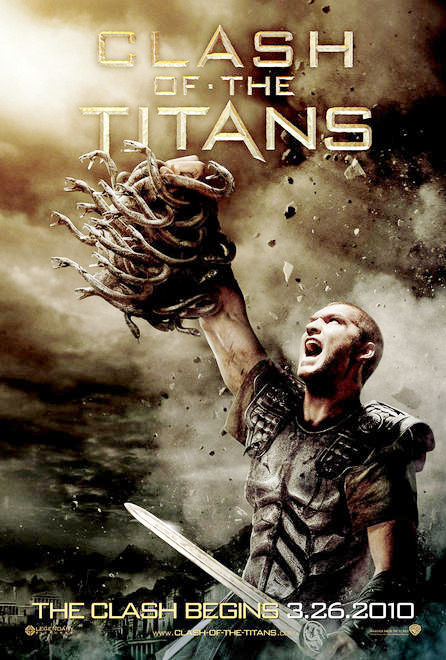
Clash of the Titans, A Masculine Disaster


I recently had the unfortunate pleasure of watching Clash of the Titans, Warner Bros. latest box office hit. For those of you who didn't know, this is indeed a remake of the classic 1981 film with the same title. This male dominated movie is nothing more then a bunch of guys killing things and shouting corny one liners to each other.

-WARNING SPOILERS-

Sam Worthington, of James Cameron's "Avatar", plays Perseus a demigod, (half man, half god), trying to discover who he is. Early on in the film the audience learns that Perseus is indeed the bastard son of Zeus, the king of the gods.

Zeus, portrayed by Liam Neeson, is a "god", whose persona is very much what we view in our society today as manly or masculine. Within the first fifteen minutes of the film, he plans to "punish" the humans for their lack of worship towards them. With little council to any of the few female gods, or any of the other gods for that matter, Zeus decides to destroy the human's most precious city, Argos. Though the human race is not necessarily a female person, per say, Zeus does this to establish his dominance and gain the love of the humans once more. This idea of gaining love by violent means is a dangerous and usually unsuccessful way to do so, yet it is an idea that is still instilled in a lot of the media that we consume. Martin Luther King Jr. put it bluntly, "Returning violence for violence multiplies violence, adding deeper darkness to a night already devoid of stars... Hate cannot drive out hate: only love can do that."

Perseus, our protagonist, is much like the strong action hero that began to get famous in the 80's. He's ripped, sexy, and can beat the crap out of anything. Though he wears a skirt through most of the film, his traditional masculinity is not questioned. He shows no emotion accept anger and hate towards the gods who killed his human family. Even when his love interest, Lo, (a demigod like himself) is killed brutally onscreen, the only emotion shown is that of anger which in turn leads to revenge. Can "real" men not cry, or show any type of sympathy? Apparently not in the mythological, patriarchal realm where this story unfolds. It seems in order for one to be considered masculine he must possess strength, be bent on revenge and care only for himself.

Although this movie did have its moments, it suffered greatly due to what I would like to call, the "dude factor" aka the hyper-masculinity. The few female characters involved in the plot are either love interests or villains who end up being killed, once again establishing male dominance and supporting the idea that women are to be seen and not heard.